|
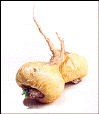 The South American country of Peru is home to numerous beneficial plants,
including maca, a legendary sex-enhancing root passed down from the Inca. I'd
heard about maca for years. It has been dubbed "Peruvian ginseng,"
even though it bears no relation to ginseng. But like ginseng, the plant is
employed to increase strength, energy, stamina, libido and sexual function, a
winning combination of health benefits if there ever was one. The South American country of Peru is home to numerous beneficial plants,
including maca, a legendary sex-enhancing root passed down from the Inca. I'd
heard about maca for years. It has been dubbed "Peruvian ginseng,"
even though it bears no relation to ginseng. But like ginseng, the plant is
employed to increase strength, energy, stamina, libido and sexual function, a
winning combination of health benefits if there ever was one.
To investigate maca's health benefits and understand the role that maca plays
in Peruvian culture, my wife and I headed down to Peru to explore the maca
trail. In the process we met with maca traders, growers and scientists, and came
back tremendously impressed by this plant, which is now available as a
supplement in U.S. health food stores.
What is Maca?
Maca, Lepidium meyenii, is an annual plant which produces a radish-like root.
The root of maca is typically dried and stored, and will easily keep for seven
years. The plant is cultivated in the Junin plateau of Peru's Central Highlands,
and was highly revered by the Inca.
During the height of the Incan empire, legend has it that Incan warriors
would consume maca before entering into battle. This would make them fiercely
strong. But after conquering a city the Incan soldiers were prohibited from
using maca, to protect the conquered women from their powerful sexual impulses.
Thus as far back as 500 years ago, maca's reputation for enhancing strength,
libido and fertility was already well established in Peru.
Today, maca's popularity is very much on the increase, as people discover
that the plant really does boost libido, sexual function and overall energy.
Acreage in Peru dedicated to Maca cultivation is increasing every year to meet
demand, and a number of scientists have turned their attention to the properties
of the root. In Peru, maca is used by men and by women who want to put more fire
into their sex lives. And in the U.S., Europe and Japan, dietary supplements
containing maca are gaining ardent devotees.
Maca Nutrition
What natural ingredients in maca promote its reputed sex-enhancing
effects? In-depth analysis of maca conducted in 1998 by Dr. Qun Yi Zheng and his
colleagues at PureWorld Botanicals shows that maca contains about 10 percent
protein, almost 60 percent carbohydrate, and an assortment of fatty acids. These
ingredients are common and nothing special. But the investigators also
discovered two groups of novel compounds, the macamides and the macaenes. These
agents are believed to be directly responsible for maca's sex-boosting powers.
To test this idea, researchers conducted a series of controlled animal
experiments, the results of which were published in the April 2000 issue of the
medical journal Urology. Rodents fed MacaPure extract, which contains a
concentration of macamides and macaenes, demonstrated greatly increased energy
and stamina. The animals also exhibited a striking increase in sexual activity
as compared with non-maca-fed animals, or those fed lesser amounts of macamides
and macaenes. So how does this translate to humans? Individuals who consume maca
also get sexual results. Men and women with low libido feel a boost in sexual
desire, and men with erectile problems notice marked improvement in sexual
function.
|